 Add to Chrome
 Add to Firefox
 Add to Edge
Representation Forcing for Bottleneck-Free Unified Multimodal Models
May 29, 2026
Unified multimodal models (UMMs) aim to handle perception and generation in a single model. Yet existing UMMs still rely on a frozen, separately pretrained VAE for image generation, imposing a structural bottleneck. Naively removing it introduces a quality gap, as the model must learn both high-level structure and low-level details from raw pixels. In this paper, we propose Representation Forcing (RF), a technique that closes this gap by making representation prediction a native capability of the model. Concretely, RF forces the decoder to autoregressively predict visual representations as intermediate tokens before pixels; these tokens then stay in context to guide pixel diffusion within the same backbone. By turning representations from perception outputs into generation targets, RF eliminates the need for any external generative latent space. We find that RF benefits both understanding and generation. On image generation, our pixel-space model with RF matches state-of-the-art VAE-based unified models. On image understanding, pixel-space RF generally outperforms its VAE-based variant. Together, these results offer an effective step toward end-to-end, bottleneck-free UMMs.

Explicit Critic Guidance for Aligning Diffusion Models
May 26, 2026Online reinforcement learning is becoming increasingly important for aligning diffusion models with non-differentiable objectives. However, existing methods still face limitations in assigning fine-grained credit along denoising trajectories and in realizing stable value-based optimization. We propose a state-aligned latent actor-critic framework for diffusion post-training, in which the diffusion model serves as its own timestep-conditioned value function and predicts values directly on noisy latent states. This enables trajectory-level PPO training, supports stable actor-critic optimization with simple conditioning and value pretraining strategies, and naturally allows the learned critic to be reused for inference-time steering. We further extend the framework to multi-reward optimization, where joint training with complementary rewards helps alleviate reward hacking. Across both UNet- and DiT-based backbones, our method consistently outperforms prior group-relative RL and actor-critic baselines on single-reward and multi-reward benchmarks, while test-time steering provides additional gains in generation quality.
Context Unrolling in Omni Models
Apr 23, 2026We present Omni, a unified multimodal model natively trained on diverse modalities, including text, images, videos, 3D geometry, and hidden representations. We find that such training enables Context Unrolling, where the model explicitly reasons across multiple modal representations before producing predictions. This process enables the model to aggregate complementary information across heterogeneous modalities, facilitating a more faithful approximation of the shared multimodal knowledge manifold and improving downstream reasoning fidelity. As a result, Omni achieves strong performance on both multimodal generation and understanding benchmarks, while demonstrating advanced multimodal reasoning capabilities, including in-context generation of text, image, video, and 3D geometry.
Continuous Adversarial Flow Models
Apr 13, 2026We propose continuous adversarial flow models, a type of continuous-time flow model trained with an adversarial objective. Unlike flow matching, which uses a fixed mean-squared-error criterion, our approach introduces a learned discriminator to guide training. This change in objective induces a different generalized distribution, which empirically produces samples that are better aligned with the target data distribution. Our method is primarily proposed for post-training existing flow-matching models, although it can also train models from scratch. On the ImageNet 256px generation task, our post-training substantially improves the guidance-free FID of latent-space SiT from 8.26 to 3.63 and of pixel-space JiT from 7.17 to 3.57. It also improves guided generation, reducing FID from 2.06 to 1.53 for SiT and from 1.86 to 1.80 for JiT. We further evaluate our approach on text-to-image generation, where it achieves improved results on both the GenEval and DPG benchmarks.
VTok: A Unified Video Tokenizer with Decoupled Spatial-Temporal Latents
Feb 04, 2026This work presents VTok, a unified video tokenization framework that can be used for both generation and understanding tasks. Unlike the leading vision-language systems that tokenize videos through a naive frame-sampling strategy, we propose to decouple the spatial and temporal representations of videos by retaining the spatial features of a single key frame while encoding each subsequent frame into a single residual token, achieving compact yet expressive video tokenization. Our experiments suggest that VTok effectively reduces the complexity of video representation from the product of frame count and per-frame token count to their sum, while the residual tokens sufficiently capture viewpoint and motion changes relative to the key frame. Extensive evaluations demonstrate the efficacy and efficiency of VTok: it achieves notably higher performance on a range of video understanding and text-to-video generation benchmarks compared with baselines using naive tokenization, all with shorter token sequences per video (e.g., 3.4% higher accuracy on our TV-Align benchmark and 1.9% higher VBench score). Remarkably, VTok produces more coherent motion and stronger guidance following in text-to-video generation, owing to its more consistent temporal encoding. We hope VTok can serve as a standardized video tokenization paradigm for future research in video understanding and generation.
Seedance 1.5 pro: A Native Audio-Visual Joint Generation Foundation Model
Dec 23, 2025Recent strides in video generation have paved the way for unified audio-visual generation. In this work, we present Seedance 1.5 pro, a foundational model engineered specifically for native, joint audio-video generation. Leveraging a dual-branch Diffusion Transformer architecture, the model integrates a cross-modal joint module with a specialized multi-stage data pipeline, achieving exceptional audio-visual synchronization and superior generation quality. To ensure practical utility, we implement meticulous post-training optimizations, including Supervised Fine-Tuning (SFT) on high-quality datasets and Reinforcement Learning from Human Feedback (RLHF) with multi-dimensional reward models. Furthermore, we introduce an acceleration framework that boosts inference speed by over 10X. Seedance 1.5 pro distinguishes itself through precise multilingual and dialect lip-syncing, dynamic cinematic camera control, and enhanced narrative coherence, positioning it as a robust engine for professional-grade content creation. Seedance 1.5 pro is now accessible on Volcano Engine at https://console.volcengine.com/ark/region:ark+cn-beijing/experience/vision?type=GenVideo.
End-to-End Training for Autoregressive Video Diffusion via Self-Resampling
Dec 17, 2025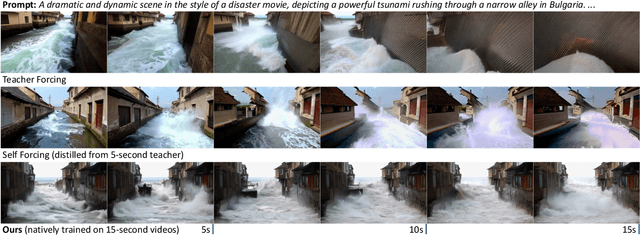
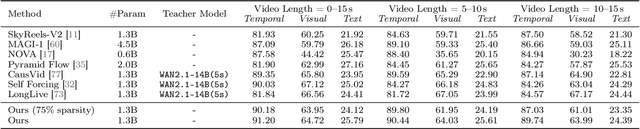
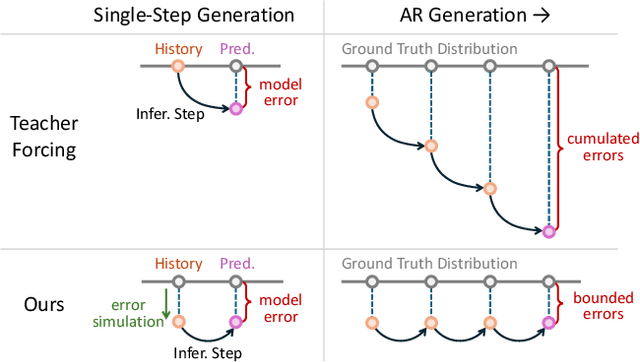
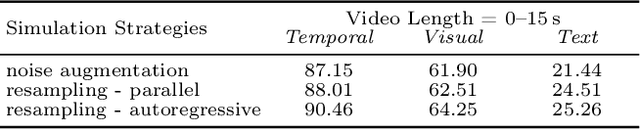
Autoregressive video diffusion models hold promise for world simulation but are vulnerable to exposure bias arising from the train-test mismatch. While recent works address this via post-training, they typically rely on a bidirectional teacher model or online discriminator. To achieve an end-to-end solution, we introduce Resampling Forcing, a teacher-free framework that enables training autoregressive video models from scratch and at scale. Central to our approach is a self-resampling scheme that simulates inference-time model errors on history frames during training. Conditioned on these degraded histories, a sparse causal mask enforces temporal causality while enabling parallel training with frame-level diffusion loss. To facilitate efficient long-horizon generation, we further introduce history routing, a parameter-free mechanism that dynamically retrieves the top-k most relevant history frames for each query. Experiments demonstrate that our approach achieves performance comparable to distillation-based baselines while exhibiting superior temporal consistency on longer videos owing to native-length training.
Mixture of Contexts for Long Video Generation
Aug 28, 2025Long video generation is fundamentally a long context memory problem: models must retain and retrieve salient events across a long range without collapsing or drifting. However, scaling diffusion transformers to generate long-context videos is fundamentally limited by the quadratic cost of self-attention, which makes memory and computation intractable and difficult to optimize for long sequences. We recast long-context video generation as an internal information retrieval task and propose a simple, learnable sparse attention routing module, Mixture of Contexts (MoC), as an effective long-term memory retrieval engine. In MoC, each query dynamically selects a few informative chunks plus mandatory anchors (caption, local windows) to attend to, with causal routing that prevents loop closures. As we scale the data and gradually sparsify the routing, the model allocates compute to salient history, preserving identities, actions, and scenes over minutes of content. Efficiency follows as a byproduct of retrieval (near-linear scaling), which enables practical training and synthesis, and the emergence of memory and consistency at the scale of minutes.
Captain Cinema: Towards Short Movie Generation
Jul 24, 2025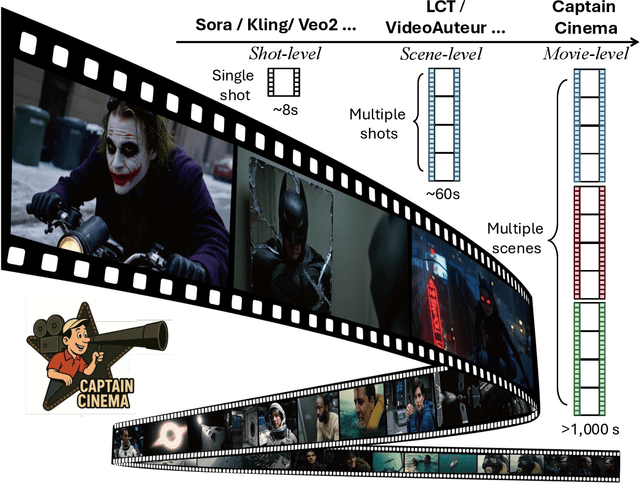
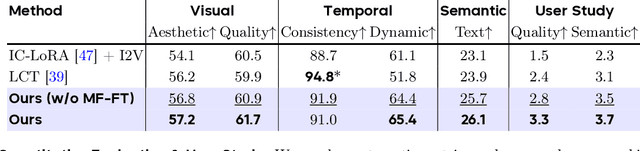
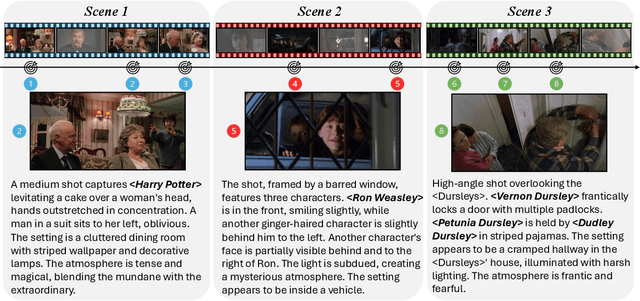
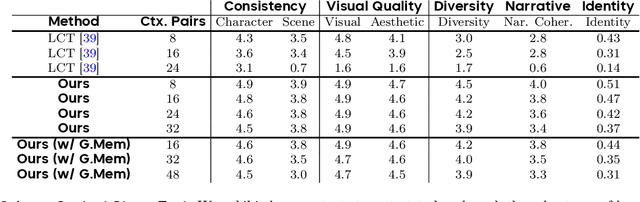
We present Captain Cinema, a generation framework for short movie generation. Given a detailed textual description of a movie storyline, our approach firstly generates a sequence of keyframes that outline the entire narrative, which ensures long-range coherence in both the storyline and visual appearance (e.g., scenes and characters). We refer to this step as top-down keyframe planning. These keyframes then serve as conditioning signals for a video synthesis model, which supports long context learning, to produce the spatio-temporal dynamics between them. This step is referred to as bottom-up video synthesis. To support stable and efficient generation of multi-scene long narrative cinematic works, we introduce an interleaved training strategy for Multimodal Diffusion Transformers (MM-DiT), specifically adapted for long-context video data. Our model is trained on a specially curated cinematic dataset consisting of interleaved data pairs. Our experiments demonstrate that Captain Cinema performs favorably in the automated creation of visually coherent and narrative consistent short movies in high quality and efficiency. Project page: https://thecinema.ai
UniMC: Taming Diffusion Transformer for Unified Keypoint-Guided Multi-Class Image Generation
Jul 03, 2025Although significant advancements have been achieved in the progress of keypoint-guided Text-to-Image diffusion models, existing mainstream keypoint-guided models encounter challenges in controlling the generation of more general non-rigid objects beyond humans (e.g., animals). Moreover, it is difficult to generate multiple overlapping humans and animals based on keypoint controls solely. These challenges arise from two main aspects: the inherent limitations of existing controllable methods and the lack of suitable datasets. First, we design a DiT-based framework, named UniMC, to explore unifying controllable multi-class image generation. UniMC integrates instance- and keypoint-level conditions into compact tokens, incorporating attributes such as class, bounding box, and keypoint coordinates. This approach overcomes the limitations of previous methods that struggled to distinguish instances and classes due to their reliance on skeleton images as conditions. Second, we propose HAIG-2.9M, a large-scale, high-quality, and diverse dataset designed for keypoint-guided human and animal image generation. HAIG-2.9M includes 786K images with 2.9M instances. This dataset features extensive annotations such as keypoints, bounding boxes, and fine-grained captions for both humans and animals, along with rigorous manual inspection to ensure annotation accuracy. Extensive experiments demonstrate the high quality of HAIG-2.9M and the effectiveness of UniMC, particularly in heavy occlusions and multi-class scenarios.